Starlink Mobile vs Amazon Leo: live phone coverage versus a planned network
Compare Starlink Mobile and Amazon Leo’s satellite-to-phone plans: current service, handset compatibility, spectrum, speeds and rollout milestones.
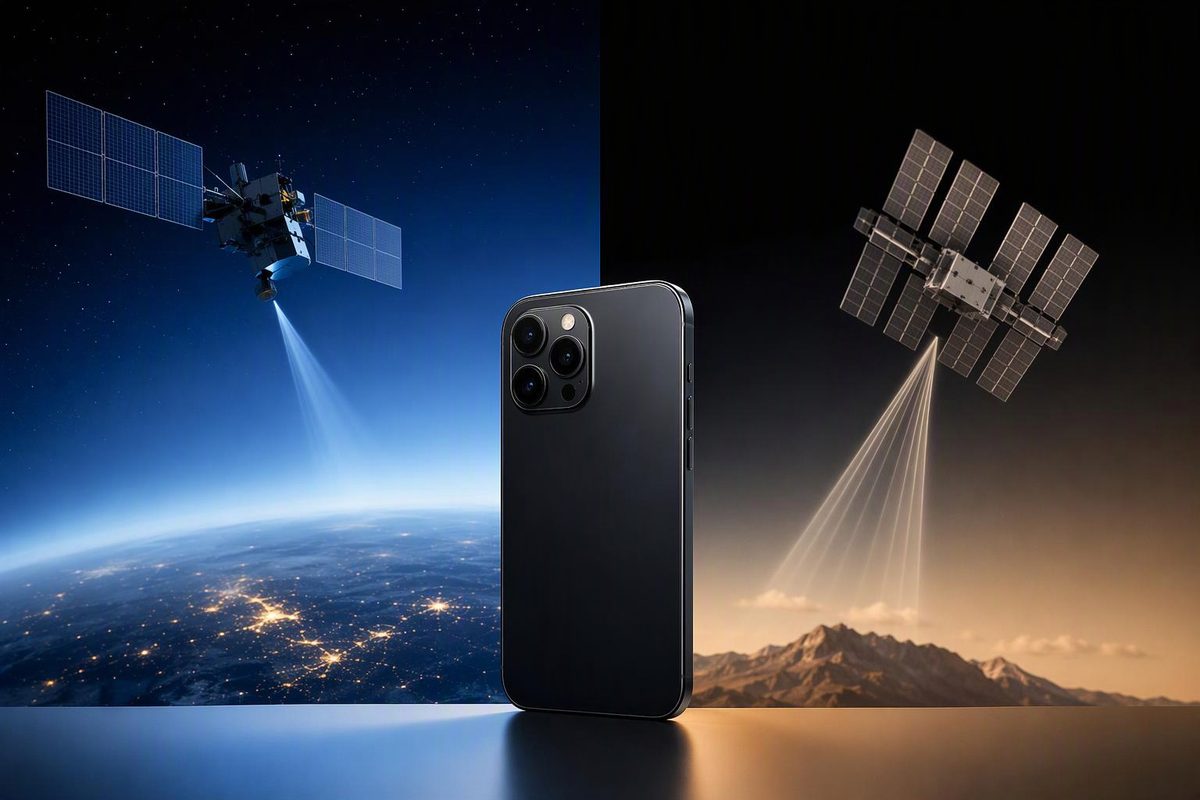
Starlink Mobile already supports satellite-to-phone services through mobile operators. Amazon Leo’s new direct-to-device network is a future deployment, planned to begin in 2028. As of 27 October 2026, this is not a comparison between two equivalent mobile subscriptions: one has live carrier services; the other has a proposed new constellation and a planned acquisition of Globalstar. (Starlink, Amazon–Globalstar announcement)
There is also a naming trap. Amazon Leo includes terminal-based satellite broadband as well as its proposed direct-to-device service. A phone using Wi-Fi from a Leo terminal is not connecting directly to a satellite.
What is live, and what is planned?
Direct-to-device (D2D) means the satellite communicates with the handset itself, rather than a separate broadband antenna.
| Question | Starlink Mobile | Amazon Leo D2D |
|---|---|---|
| Can it serve phones today? | Live through participating operators; availability and features vary by market. | The new Leo D2D system is planned, not a current equivalent to Starlink’s carrier services. |
| What does the service support? | Messaging, selected apps and app-based voice today. Starlink distinguishes these from future native calling and broader broadband capabilities. | Amazon plans advanced voice, data and messaging services. |
| Which phones? | Existing compatible Long Term Evolution (LTE/4G) phones, subject to the operator’s supported-device list. | Do not assume every existing phone will qualify; check future device and operator requirements. |
| How would customers get it? | Through mobile-network partners, such as T-Mobile in the US. | Amazon plans to work with mobile operators and other partners, including Apple. |
These distinctions follow the companies’ current Starlink Mobile description and Amazon’s D2D announcement. They are not guarantees of worldwide availability.
Globalstar is an important exception to “Amazon’s network is planned.” Globalstar already supplies Apple satellite features, including emergency messaging and location sharing on supported devices and in supported regions. Amazon agreed to acquire that operating business; the April announcement expected the transaction to close in 2027, subject to conditions. Those existing features are distinct from Amazon’s new Leo D2D constellation. (Apple support, transaction terms)
Follow one phone connection
Imagine a US customer with T-Satellite enabled, a compatible phone and an open view of the sky, but no available terrestrial service. T-Mobile says the phone connects automatically and can use messaging and selected satellite-ready apps, including WhatsApp voice chat. It also warns that speeds are limited and connections can have gaps or time-outs. Even satellite emergency messaging may be delayed or unavailable. (T-Mobile service details)
The simplified journey is:
Phone → satellite radio link → satellite transport network → ground network → mobile service and internet destination.
Starlink describes the satellite antenna as a cellphone tower in space. Laser links connect satellites, and the service integrates with mobile networks similarly to a roaming partner. The satellite changes the phone’s access link; it does not remove the need for ground networks or the mobile operator’s systems. (Starlink architecture)
The links carrying traffic from the satellite radio access towards the operator’s core perform the backhaul role. For the wider picture, see what backhaul does and how Starlink routes internet traffic.
Amazon’s proposed D2D architecture has the same broad separation: a handset radio link, optical links between satellites, and separate high-frequency feeder links connecting the space network to ground infrastructure. The Federal Communications Commission (FCC) describes those links in its notice accepting Amazon’s application.
The next-generation networks use different orbits and spectrum
The headline constellation numbers describe new systems, not satellite fleets already delivering the advertised future service.
- SpaceX: The FCC’s order, adopted and released on 6 October 2026, authorizes 15,000 D2D satellites in nine orbital shells at 326–335 kilometres. It grants some requests and defers others, with operating conditions attached. (FCC authorization)
- Amazon: Its application, filed on 24 July 2026 and accepted for filing on 18 August, proposes 5,105 satellites at 510–580 kilometres. Acceptance for filing opens regulatory review; it is not authorization to operate. (FCC public notice)
Spectrum—the licensed radio frequencies carrying the signal—is as important as altitude. SpaceX’s new authorization combines mobile satellite service (MSS) spectrum with Supplemental Coverage from Space (SCS), the US framework for satellite coverage using terrestrial wireless spectrum. Its authority in several EchoStar-related bands is conditional on completing the second step of that spectrum transaction. (FCC order)
Amazon’s proposed US handset links use approximately 1.6 GHz uplink and 2.5 GHz downlink spectrum associated with Globalstar: specifically, 1610–1618.725 MHz and 2483.5–2500 MHz. Its application does not request US SCS authority at this stage. That matters for compatibility: a phone must support the relevant radio bands and service, not merely have “5G” on its specification sheet. (FCC application notice)
Globalstar’s separately authorized C-3 system is another layer, not the 5,105-satellite Leo proposal. Globalstar announced its US authorization on 19 October, with launches expected to begin in 2027. (Globalstar announcement)
Which will be faster?
There is no like-for-like retail speed result to compare yet. SpaceX is targeting up to 150 Mbps per user for its next-generation Starlink Mobile system, according to Light Reading. Mbps means megabits per second. That figure is a target, not a measured promise for today’s T-Satellite connection. (Light Reading)
Nor should Amazon Leo terminal speeds be treated as phone speeds. Amazon advertises up to 400 Mbps downloads for Leo Pro, a dedicated 11-by-11-inch broadband antenna. That figure says nothing about the throughput of a handset talking directly to a Leo D2D satellite. (Amazon terminal specifications)
A lower orbit shortens the radio path, but altitude alone does not determine application performance. Capacity, spectrum, signal conditions and the route through the ground network also matter. Current carrier limitations are more useful to a buyer than future peak-speed targets.
What to check before choosing
For coverage now, check your operator’s satellite coverage map, exact phone model, supported apps and plan eligibility. Starlink’s partner list is not proof that every listed country has the same live service.
For future Amazon Leo D2D, watch for operating authorization, actual deployments, supported handsets and a retail offer in your country—not just the planned 2028 deployment start.
For home or portable broadband, compare terminal-based Leo service with terminal-based Starlink service instead. The decisive question is simple: does your phone supply the satellite radio link, or does a separate antenna supply your internet connection?